
Summary
- Private equity is a good asset class to hold in order to take advantage of sell-offs in the public and private markets.
- Strong historic fee-earning AUM growth at both Blackstone and Brookfield Asset Management point to reliable earnings growth in the quarters to come.
- Despite some poorly timed contrarian value investments in malls, office, hotels and midstream energy, the majority of their investment funds show eye-popping IRRs.
- I give Brookfield Asset Management a slight edge over Blackstone due to its more permanent equity investments in Brookfield Property Partners, Brookfield Renewable Partners, Brookfield Infrastructure Partners and Brookfield Business Partners.
- Looking for a helping hand in the market? Members of High Yield Landlord get exclusive ideas and guidance to navigate any climate. Get started today »
I last wrote about Blackstone (BX) in October 2019 after the stock had taken an 11.5% haircut in a week’s time, settling in at around $46 a share. I argued that while the stock is a great long-term buy-and-hold, outperforming the broad market by around 27% in the trailing year meant that it was no longer a great value. Blackstone then went on to reach as high as $64 per share before the pandemic brought the whole market crashing down.
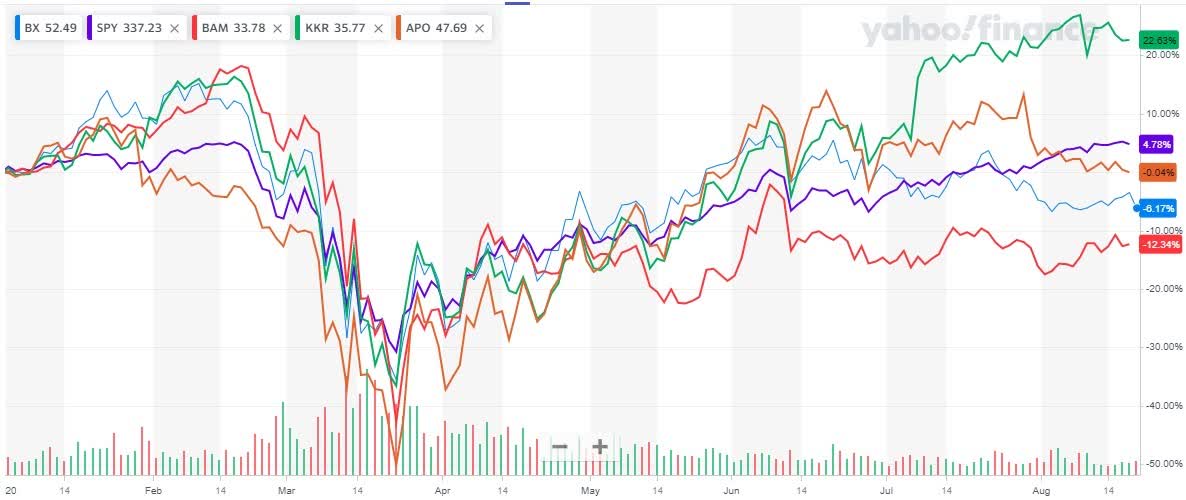
Image from Yahoo Finance
In the chart above, you can see that except for KKR & Co. (KKR), the top private equity firms (BX is blue, Brookfield Asset Management (BAM) is red) have underperformed the market (in purple) YTD. This is most likely due to its heavy allocation to tech and growth, which have been trouncing value, real estate and energy, which make up a good portion of private equity target investments.
The business model of private equity mainly revolves around accumulating the most cash and investments as possible through fundraising so that you can then earn base and performance fees from those assets. The base management fees, typically around 2%, are highly predictable, as they do not require any sort of performance in order for them to be earned. Coupled with long lockup periods (5-10 years) before capital can be withdrawn, a significant amount of the business is predictable.
In addition to this predictable base rate of fees, there are also performance fees and carried interest. Simply put, upon achieving some agreed-upon performance hurdle, say 7-8% return, Blackstone is entitled to somewhere around 20% of the excess profits as incentive. This part of the business, while lucrative, is not as predictable, and we have recently seen a decent write-down to unrealized carried interest and expected future performance fees. Blackstone may also make its own equity investments either in its funds or outside of them, but this is a tiny part of the company's balance sheet.
If the most important part of the business comes from fees earned on Assets Under Management, that’s where we should focus our attention. Some funds are not immediately subjected to fees, which is why total AUM differs from fee-earning AUM. While this will eventually become fee-bearing AUM, I choose to focus on the latter.

